
Projected vs Actual Release Date
A projected date is a calculation, not proof that release happened. TDCJ uses the exact label “Projected Release Date” for its estimate under the governing sentence, credits, eligibility rules, and record data. The actual release date records an event after custody ends or transfers. A maximum sentence date is another calculation, and a parole eligibility date only marks when review may become possible.
A Hall County pretrial detainee usually has no fixed sentence-release date. Release depends on bond, a court order, case disposition, or another custody event. A sentenced county-jail inmate has a local computation. A sentenced state prisoner has a TDCJ computation. Mixing those systems produces bad answers.
Find Hall County Projected Release Dates
Start by identifying who holds the person. Hall County Jail, TDCJ, and a federal institution calculate dates under different rules. A blank county result cannot be treated as a state release. Likewise, a TDCJ projection does not describe a sentence served only in Hall County Jail.
- Ask Hall County dispatch whether the person is in county custody, was booked out, or transferred. Use the full booked name and another identifier.
- For a county sentence, request the sheriff’s computation and book-out record. Obtain the judgment and jail-credit orders through the combined clerk.
- For TDCJ, search by seven-digit TDCJ number or SID when possible. Otherwise use last name and first initial, then match age, county, offense, and case data.
- Read projected release, maximum sentence, parole eligibility, review information, and current status as distinct fields.
- If the public result is unclear, email pia@tdcj.texas.gov with the identifying details and ask for the projected date and incarceration history.
The Hall County released inmate search covers the wider records chain when the custodian is uncertain.
Texas Release Credit Rules
Texas does not have one universal rule requiring every person to serve a fixed percentage of every sentence. Offense date, offense category, sentence structure, parole eligibility, and mandatory-supervision law all matter. Government Code Chapter 498 governs TDCJ good-conduct time. It states that good time is not a reduction of the sentence itself. It affects eligibility for parole or mandatory supervision only as the law permits.
TDCJ’s definition also changes with the offense date. For eligible offenses before September 1, 1996, its official page says a person not paroled releases on the projected date. For later offenses eligible for mandatory supervision, the Board’s decision can be part of the path. When mandatory supervision is denied or unavailable, TDCJ says the projected date is the discharge date. This makes the field conditional.
County confinement is different. Texas Code of Criminal Procedure Article 42.032 supplies a framework for county-jail good-conduct credit and places administration with the sheriff under its stated conditions. It does not publish Hall County’s person-specific arithmetic. The judgment, credited time, and sheriff’s computation control.
Why Hall County Release Dates Move
A date can change when TDCJ or Hall County receives information that was not in the earlier calculation. Preserve the date and retrieval time when checking a dynamic record. If two dates conflict, ask the custodian to explain the later calculation rather than choosing the result that seems favorable.
| Factor | Possible effect | Record to check |
|---|---|---|
| Jail credit or amended judgment | Changes credited days or sentence terms | Signed court order and custodian computation |
| Good-time loss | May change eligibility or projected timing | TDCJ or sheriff record |
| Consecutive sentence | Another term must run in sequence | Judgments and sentence history |
| Detainer or hold | Release from one custodian becomes transfer | Book-out entry and receiving agency |
| Board action | Approval, denial, or later review affects parole path | TDCJ and Board status |
| Federal recalculation | Projected BOP date may move | BOP record |
Parole approval is not the same as walking out that day. Release planning and conditions may remain. Denial may set another review point. A court order can also resolve one case while another cause or agency hold continues.
Confirm Hall County Actual Release
For Hall County Jail, ask for the book-out time, release type, authority, and receiving agency. A transfer closes the local booking but does not mean community release. The clerk’s judgment or bond order explains the legal reason, though it may not show the minute jail staff completed release.
For state prison, recheck TDCJ status after the projected date. If ambiguity remains, request incarceration history and release or discharge details. Texas IVSS-Counties, if Hall participates, may send county events. TDCJ IVSS is the separate notification route for state prison and parole events. A notification is timely corroboration, not a certified discharge record.
The current county notification system replaced legacy VINE in Texas. The VINELink inmate check page explains the modern IVSS split and how to select the correct custody layer.
Three Hall County Release Calculations
A local arrest can lead to three distinct systems. Hall County Jail uses the county judgment, jail credit, and sheriff computation. TDCJ uses Texas prison records and Chapters 498 and 508. BOP uses federal sentence records and its own credit rules. The fact that the arrest began in Hall County does not make later state or federal dates county calculations.
Hall County does not publish a county-jail good-time rate or weekend-release practice. No reliable public source supports adding a stock weekend adjustment. Call the sheriff for the actual calculation and pickup instructions. If a record says transfer, follow the named receiving system before describing the person as released.
The TDCJ email information page provides a useful fallback. It asks for a full name and TDCJ number, or birth date or approximate age plus county of conviction. The service is free and includes Projected Release Date among available information, but it does not provide photographs.
The official TDCJ projected-date explanation shows the identifying fields and definition used by the agency.
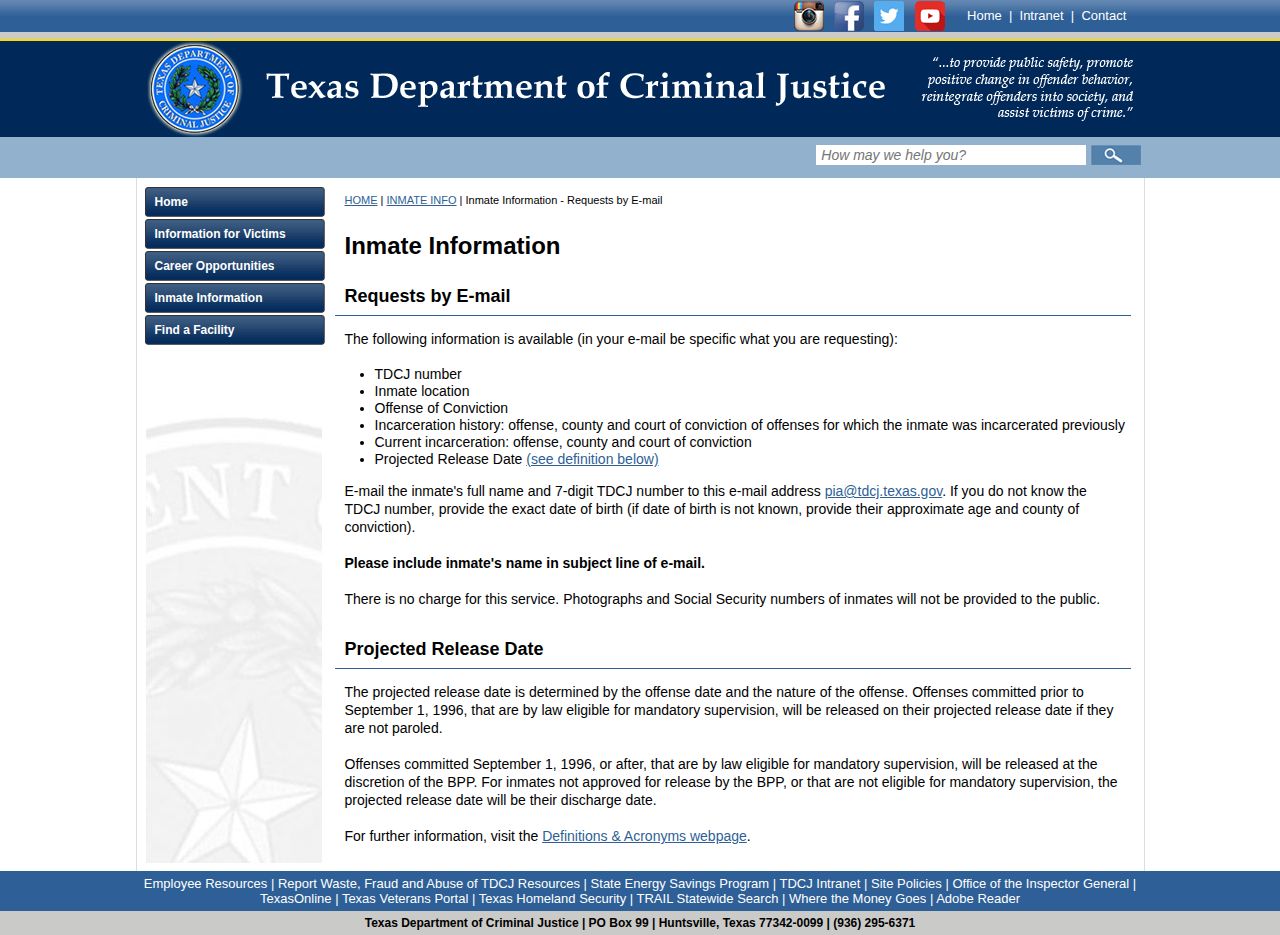
The agency page is stronger than a date copied from an old search result because it defines what the label means.
Hall County Date Identity Checks
A federal case adds another distinction. The Bureau of Prisons locator can display a future projected date, which may change after credit calculations. A past date with no institution means the person is no longer in BOP custody, but it does not establish that all custody or supervised release ended. A federal pretrial defendant held under U.S. Marshals authority may never appear as a sentenced BOP inmate. In that setting, the federal docket and release order may be more useful.
Identity controls also prevent a false match. Compare at least two points beyond the name, such as birth date, age, TDCJ or SID number, cause number, offense, and county of conviction. Record when the result was retrieved. A screenshot preserves what a portal displayed, while the custodian’s written response is stronger when exact status matters.
Public Record Search
Sponsored Results
Hall County Sentence Computation Records
When a Hall County sentence date seems wrong, gather the judgment, jail-credit order, related cause numbers, and the custodian’s computation. Concurrent sentences may run together under the orders, while consecutive sentences can extend time. Do not calculate from a news report or sentence length alone. The record may contain time-served credit, an amended judgment, or a second case that changes the endpoint.
Ask the Sheriff for the computation when a sentence is served locally. Ask TDCJ for projected-date and incarceration-history information in state custody. The clerk provides signed orders but does not run the jail or prison calculation. This division explains why a docket date can differ from physical book-out time.
A hold changes the meaning of release. If Hall County closes a booking and transfers the person to another county, TDCJ, federal authorities, or immigration custody, the local exit is real but not a community release. Ask for the receiving agency and transfer date, then check that system after intake.
Keep the labels precise when recording the result. “Projected” states an agency forecast. “Eligible” states that review may be possible. “Approved” states a Board decision, not necessarily a release event. “Released” identifies departure from that custodian, and “discharged” identifies the legal endpoint recorded by the responsible system. If the terms conflict, request the underlying history and written explanation. Hall County dispatch, the clerk, TDCJ, BOP, and notification portals each see only their part of the custody chain. The record from the agency that held the person is the best source for its own exit date.
Recheck dynamic dates after any new court order, disciplinary action, sentence credit, Board vote, or receiving-agency transfer appears.