
Hall County Parole vs Probation
Parole and probation place a person in the community, but they begin in different ways. Parole follows release from TDCJ while the prison sentence continues under rules set for that release. Mandatory supervision is another form of supervised state release governed by statute. Probation, which Texas law often calls community supervision, comes from a court. It may replace a prison term or follow a short jail condition. A Hall County Jail book-out entry alone does not show which system applies.
The signed judgment and later court orders are the best sources for probation. TDCJ status and the assigned district parole office are the useful sources for parole. A person who bonded out while a case is pending is not on probation merely because the person must return to court. Likewise, release from a state prison does not mean the sentence has been discharged.
| Point | Parole | Probation |
|---|---|---|
| Starting authority | Texas prison release and Board action | Sentencing court order |
| Hall County contact | Plainview District Parole Office | District Adult Probation in Memphis |
| Best public record | TDCJ offender status and parole information | Hall County judgment and supervision orders |
| How it ends | TDCJ discharge or other lawful termination | Court termination or completion |
- Parole
- Conditional community release while a state prison sentence continues.
- Probation
- Court-ordered community supervision, often imposed instead of confinement.
- Discharge
- The legal endpoint of the sentence or supervision obligation.
- Absconder
- A person alleged to have stopped reporting or whose location is unknown to supervision.
Verify Hall County Post-Release Supervision
Verification starts with the source that created the supervision. Hall County parole and probation do not share a single public lookup. TDCJ handles state parole records, while the Hall County court record establishes probation. Match the person with an identifier beyond a name, such as a birth date, TDCJ number, SID, or court cause number.
- Determine whether the release was from Hall County Jail or TDCJ. Ask the sheriff for a release type and receiving agency if the path is unclear.
- For state release, search the TDCJ Inmate Search by TDCJ number, SID, or name. Read status, projected date, and parole-review information as separate fields.
- For probation, locate the Hall County cause through the clerk’s LGS portal and read the judgment plus later modification, revocation, or termination orders.
- Call the correct office only after identifying the system. Ask whether it is the routing office and what public status can be confirmed.
- When the online result is unclear, request the existing record from TDCJ, the clerk, or the sheriff rather than inferring supervision from a jail roster result.
A current jail roster, if Hall County later publishes one, would answer current custody. It would not establish parole, probation, or discharge. The full county release path is described on the Hall County released inmates search.
Hall County Parole Office Route
TDCJ’s live county cross-reference assigns Hall County to the Plainview District Parole Office in Region V. It does not route Hall County to Amarillo. The office can explain routing and how a released person should contact an assigned officer. Privacy and safety limits may prevent staff from giving a caller detailed case information.
Plainview District Parole Office
1001 North Interstate Highway 27, Suite 232
Plainview, TX 79072
Phone: 806-293-5989
Fax: 806-293-9732
Check the official Region V directory before relying on contact details.
The City of Memphis separately lists District Adult Probation at 806-259-3388. That local number serves the court-supervision route, not state parole. The split is useful: first identify the order or state record, then contact the office tied to it.
The TDCJ county cross-reference shows the Hall-to-Plainview assignment. The directory image captured from that source confirms that office mapping rather than relying on a broad web result.
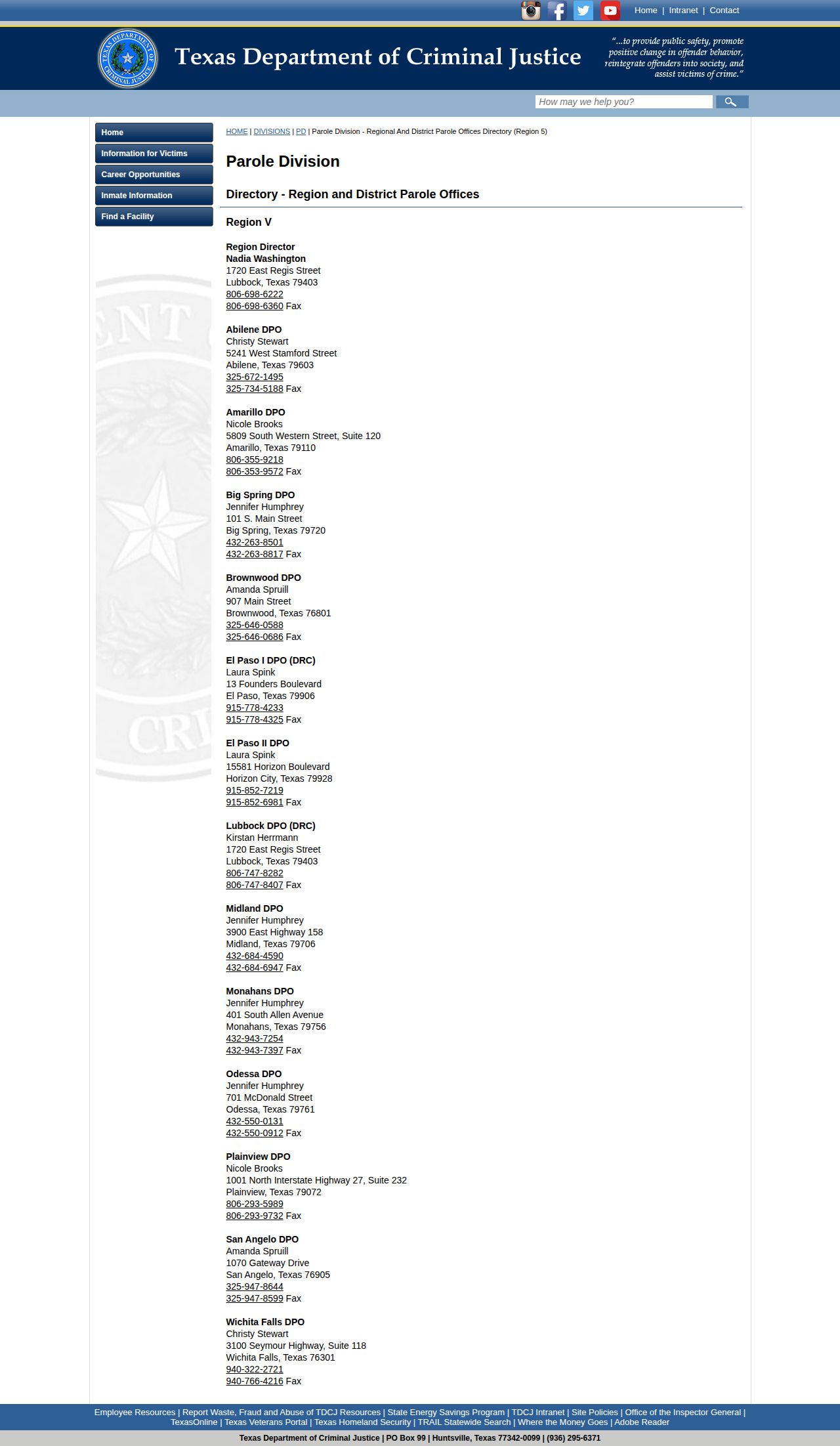
The office listing supplies a direct state source for Hall County parole routing.
Hall County Supervision Violations
Conditions differ by order and case. Common duties can include reporting, travel limits, treatment, fees, or conduct rules, but no generic list proves what applies to one person. Read the parole certificate or court order. A claimed violation may lead to investigation, a warrant, a hearing, added conditions, revocation, or no action, depending on the facts and governing process.
An absconder label means supervision alleges that the person stopped complying or cannot be located. It is not proof of a new conviction. No official Hall County sheriff absconder list or parole-warrant list was found. Old social posts and copied wanted notices can remain online after status changes, so verify through the supervising office or the authority that issued the warrant.
Texas IVSS-Counties may send county booking, release, transfer, and court-event notifications if Hall participates. TDCJ IVSS is the separate state-prison and parole notification system. Alerts help track events, but the underlying order or agency record remains the stronger proof.
How Hall County Supervision Ends
Parole ends through the lawful completion or termination reflected by TDCJ, not merely because a projected date passed. TDCJ distinguishes parole eligibility, projected release, maximum sentence, actual release, and discharge. Each label answers a different question. A person may leave prison on parole and remain supervised until discharge. Another warrant or sentence may also affect custody.
Probation ends under the sentencing court’s record. The Hall County clerk file may show an order terminating community supervision, a discharge entry, a revocation, or a later modification. The probation office can address reporting, but the signed court order supplies the durable legal account. When exact jail departure matters, pair that order with the Hall County Sheriff book-out record.
Board review is a file process, not a routine open Hall County hearing calendar. An institutional parole officer prepares a summary and a three-person panel votes. Two matching votes decide. Approval may carry conditions and may precede physical release; denial includes a later review point. Search TDCJ’s Parole Review Information or call the Board status line at 844-512-0461 with reliable identifiers.
Hall County Release Record Corrections
Hall County publishes no property-return or release-record correction procedure. Call Hall County Jail before travel and ask what identification, pickup place, and hours apply. Dispatch is staffed around the clock, while routine sheriff business hours are weekdays. Do not rely on an unverified detention address from a third-party directory.
Send a disputed sheriff release entry, identifiers, and any supporting order to the Sheriff’s Office. A wrong court docket belongs with the combined District and County Clerk. These records serve different roles, so correcting one may not change the other automatically. Ask each custodian for its process and keep the written response.
A release or correction does not itself erase an arrest record. Texas expunction and nondisclosure have separate legal standards. The clerk links state nondisclosure forms and Legal Aid of Northwest Texas, but eligibility depends on the facts and order.
Hall County Probation Court Records
The Hall County combined clerk links the LGS online records portal. Search by cause number when possible because a name can mix people or cases. Read the judgment, later modification, revocation, and termination orders. If an older order is not online, contact the clerk. Its page warns that some research access is limited while records remain in offsite storage during the courthouse transition.
A docket entry may point toward an outcome, but a signed order is stronger proof. Pair the order with the sheriff book-out entry when the precise physical release time matters.
Public Record Search
Sponsored Results